How to Begin Ancestral Healing in Your Own Body
How to begin ancestral healing in your own body — body-first practice for the patterns your nervous system inherited. Lineage work for daily life.
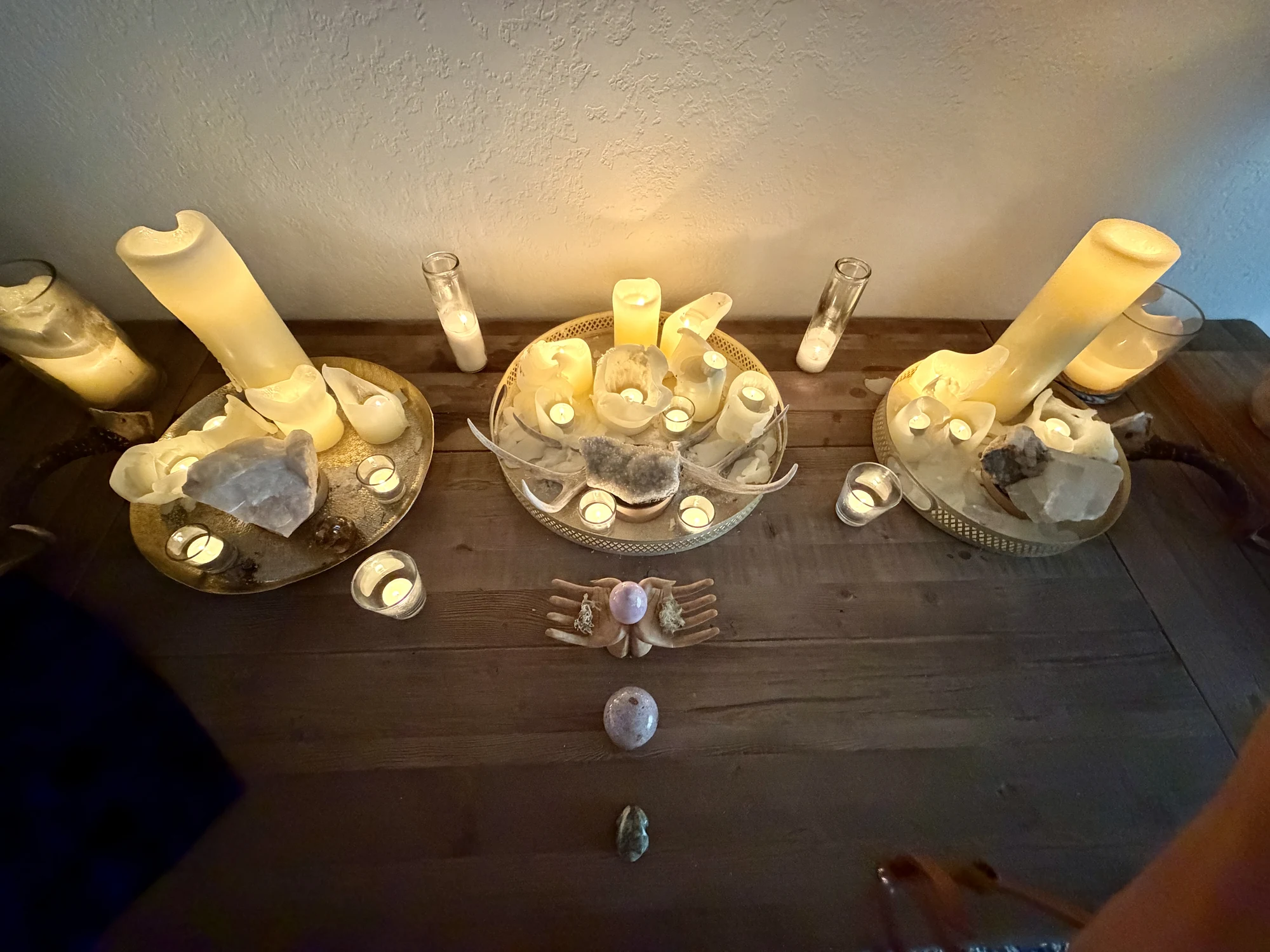
You can feel the inheritance in your body before you can name it. The shape of stress that arrived in your nervous system before your own life had earned the right to ask for it. The voice in your head that does not sound like yours when something drops or goes wrong. The tightness in your shoulders that has been there longer than the conditions of your life would explain. The reach for the override (food, scroll, busyness, drink) at the same moment of the same day, every day, in a rhythm you did not choose. There is a line older than you running through your body, and your body has been holding it for years. Where in your body do you feel the inheritance most often? What does it ask of you when no one else is asking?
In college, I was home and witnessed my dad scold himself in the kitchen when something dropped. Oh come on, David, he said to himself, sharp and disappointed. His frustration turned inward. In that moment, I noticed that the voice in my own head when I drop something or get something wrong was the same voice. Oh come on, Chandra. Same tone. Same self-disappointment. Same body cue in my chest where it landed. It was my dad’s voice, running on autopilot through me, years after he had taught it to my body. I felt something settle. I could let the voice be his. I did not have to keep handing it down.
That moment was ancestral healing in the everyday body-first form that is at the heart of my work, personal and professional.
“The first big step is awareness.”
— Zen Odyssey: The Adventure of Awareness
This post is the broadest entry into the lineage work I teach. It sits underneath the healing generational trauma post and is built for the parents and the cycle-breakers who feel the inheritance running through them and are ready to start working with it where it actually lives, in the body. What awareness has been knocking at your door lately? What pattern is asking to be seen?
What Ancestral Healing Actually Is
Ancestral healing is the practice of working with and transmuting the patterns that have moved down your family line and are now running through your nervous system, your body, and the way you show up in your own life. It is not a single modality. It can be approached through somatic practice, through working with a coach or therapist trained in the lineage layer, through family constellations work, through energy healing, through guided meditation, through cultural healing traditions specific to your family of origin, or through quiet daily practice in your own life, or some combination of these. Different countries and cultural traditions name the work differently. The therapeutic approach varies. The underlying recognition does not.
A note on ancestral medicine specifically, since the term gets used loosely: ancestral medicine, in the lineage of practitioners like Dr. Daniel Foor and in many indigenous traditions worldwide, is the practice of working directly with the ancestors as guides and healers, often involving ritual, ceremony, herbs, and altered states. It includes practices like cultivating a conscious relationship with the well ancestors (Foor’s term for the ancestors who have completed their own healing and can offer guidance) alongside ancestral guides and ancient ancestors further back than personal memory reaches. Ancestral medicine is one specific tradition-set within the broader umbrella of ancestral healing, not a synonym for it.
What unites the various approaches under the ancestral healing umbrella is the recognition that the patterns you inherited do not respond to information alone. Your family history is not a story you carry. It is a belief system and a state your nervous system runs in. The grandparent who never spoke about what they survived passed the survival pattern down anyway, in the way they parented your parent, in the body your parent grew up co-regulating with, in the body that eventually became yours. That is the inheritance. It is older than your own life experiences and more physiological than psychological. The healing process has to meet it at that level. The body of work known as ancestral healing (sometimes called ancestral lineage healing, sometimes ancestral work, sometimes ancestral heritage practice) has a significant impact on the family system precisely because the patterns it touches live below the cognitive layer. What inherited beliefs do you suspect have been running you for years? What state has your nervous system been holding that does not match your conditions?
The ancestral connection people sometimes describe (the sense that an old pattern, a felt presence, a body memory that does not match anything in your own biography just surfaced) is not necessarily mystical. Often it is the body finally getting permission to feel what has been carried in the family line. Ancestral memories can move through the physical body as a wave through the chest, a posture you suddenly recognize as your mother’s, a voice in your head you suddenly hear as your father’s. The body knew first. The mind catches up. This is what makes the work a transformative process rather than a single insight: each recognition opens deeper connections to the family stories, and the unresolved traumas, that the body has been silently carrying.
There is something else worth naming about the moment we are living in. For most of history, the kind of slow, body-first lineage work I am describing was not available to most people. Not because the patterns were not running, but because the conditions of survival did not allow the inquiry. Subsistence-level living, war, displacement, the press of just making it through the week: those conditions ask the body to keep moving, not to sit with what came down the line. Indigenous traditions and some cultural lineages held the ancestral work all along, as ceremony, as elder transmission, as ritual the whole community participated in. Western culture, by and large, lost the thread for several generations. What is opening now is a rare window. The abundance, the time, and the cultural permission to actually do this work are recent. The line behind you did not have these conditions. You do. The work you are doing in your body is, in some real sense, the work your ancestors did not have the conditions to do for themselves.
How Ancestral Patterns Move Through Bodies
There are a few mechanisms researchers and practitioners point to for how ancestral patterns get passed down.
The first is epigenetic transmission. Environmental conditions experienced by past generations (chronic stress, traumatic events, scarcity, displacement) leave marks on which genes get expressed, and those expression patterns can pass forward to subsequent generations. The science here is still being mapped, but the line of evidence is strong enough that researchers like Rachel Yehuda at Mount Sinai, who studies Holocaust survivors and their descendants, have documented measurable changes in the cortisol regulation of children of survivors who had not lived through the original event themselves, including findings on how maternal and paternal lineages each leave distinct epigenetic signatures on the offspring. The body remembers what the family system has lived through, even when no one has spoken the family stories out loud.
The second is co-regulatory transmission. A small body learns its baseline by reading the nervous system of the bigger body it grows up next to. A child whose parent’s body lives in chronic activation grows a nervous system that learns activation as the resting state. A child whose parent’s body lives in shutdown learns shutdown. The same goes for hypervigilance, for the people-pleasing reach, for the freeze response, for the pacifying habit. Your body learned its first state from the body that held you. This is regularly the strongest channel for intergenerational trauma to move forward, and for the patterns of behavior that come down the maternal line, the paternal line, or both.
The third is behavioral and linguistic transmission. The words used in the home (the suck it up, don’t cry, be strong, what’s wrong with you, why are you making a big deal lineup that I work with so many of my clients on) get internalized as the inner voice that runs on autopilot decades later. The unspoken rules about which feelings could be shown, which were too much, which had to be performed away: these become the body’s baseline relationship to its own emotional life and shape the family dynamics that future relationships continue. I cover the inner-voice and self-judgment layer in more depth in how to silence your inner critic (coming soon).
These three mechanisms work together. Most inherited patterns ride on more than one. The point of naming them is not to pick which one your particular pattern came through. The point is to see that the inheritance has body-level pathways, and that the body-level pathways are where the healing has to land. Generational traumas tend to compound across generations until someone in the family system does the work to interrupt the cycle. Which channel do you suspect your inheritance came through most strongly: the cellular layer, the nervous system you grew up next to, or the words and rules of the home you were raised in?
Recognizing the Inheritance in Your Own Body
Before you can do ancestral lineage healing in any tradition, you have to be able to feel the inheritance moving through you in real time. This is the slow work. Most of my clients have done years of cognitive work (therapy, reading, journaling) and arrived without yet having the body-level recognition that the patterns are in here rather than back there.
The recognition tends to land in a few specific shapes.
A voice in your head that turns out to be your parent’s voice. The oh come on, Chandra voice that was actually my dad’s. The don’t be so sensitive voice. The what is wrong with you voice. The you should be doing better voice. When you hear it clearly enough (slow down, listen, feel where it lands in your body), you can hear the original speaker. You can let the voice be theirs. You can stop running their program.
A posture or body shape you suddenly recognize as a parent’s. The set jaw your father carried in stress. The shoulders that ride up the way your mother’s did. The way you tighten your grip on the steering wheel the way your grandparent did on the kitchen counter. These body shapes are absorbed through years of watching the body that held you. The recognition is the first beat of softening them.
A reach for the override that does not match your conditions. Reaching for the snack the way your mother did when she was overwhelmed. Reaching for the drink the way your father did when he could not feel his own body. Reaching for the busyness the way the family line reached for it. The food and gut layer of this kind of inherited reach lives in healthy relationship with food.
A baseline state that does not match your life. A default anxiety that does not match what is actually happening for you. A chronic vigilance that does not match the safety of your conditions. A baseline of pacifying everyone that does not match what your relationships actually require. The pattern-recognition layer goes further on in generational patterns (coming soon).
A felt sense of an older line moving through you. A wave through the chest in a quiet moment that feels like a felt-presence of someone older than you. The grief that arrives without a clear reason. The body remembering something you do not have the words for. This shape is regularly what people mean when they describe the ancestral connection. It does not require a metaphysical commitment. It only requires letting your body have its experience without arguing with it.
My own ancestral work has surfaced more than one inheritance over the years. Underneath the oh come on, Chandra voice from my dad, I have also felt a baseline of scarcity in my body that came from both sides of my family. Both lines lived through times of not having enough, and what every generation does with that gets passed down. I notice it now when I catch myself wanting to hold onto things too tightly, when the what if there is not enough tightens in me before any actual scarcity is in front of me. That is the inheritance speaking. Naming it as inherited, rather than as a personal flaw or a present-moment fact, gives me a way to soften it. Multiple inheritances live in one body. The work is to feel each one as it surfaces and to give it room to move through.
Which of these recognitions has shown up for you most clearly? Which one are you not yet ready to name out loud?
The Body-First Practice for Ancestral Healing
Ancestral healing in the daily-life form I teach has three repeatable moves. They build on the body-first work that the nervous system regulation post carries (regulation is the floor underneath all of this) and they add a lineage-aware layer on top.
Notice the Inheritance Cue
The first move is to catch the moment the inheritance is running. The inner voice. The body shape. The reach. The baseline state. I rest a hand on my chest. I take a conscious breath. I ask: whose voice is this? whose body am I holding right now? whose pattern is moving through me?
The asking itself is a regulation move. It interrupts the autopilot. It puts a beat between the inherited program and what you do next. You do not need to know the exact ancestor. My dad’s voice is enough. My mother’s stress posture is enough. The line further back than I have stories for is enough. The naming is what matters.
Let the Body Feel It
The second move asks for more from the body. Once the inheritance is named, do not move past it. Stay. Three slow breaths with the exhale longer than the inhale. Feel where the pattern lives in your body, where the voice lands, where the posture grips, where the reach pulls from. Let the sensation be there. Let it move if it wants to move. Tears, a wave, a softening, a heat: the body has its own grammar for emotional release of what it has been carrying. You can ask the sensation if it has something to say or to let you know. Emotional pain, when it has somewhere safe to go, often moves through faster than the mind expected. Some of my clients describe the work as the most powerful ways their body has ever cleared what was older than them: chronic pain easing, chronic health issues softening, ancestral wounds finally getting the conditions to close.
This is where the somatic-experiencing lineage’s phrase issues in the tissues points. The inheritance has been stored in the body. The body is the place where it can finally move through. It is common to have spent years trying to think your way out of the inheritance. The body never got to feel it. Healing requires letting the body feel it, slowly, in conditions safe enough for the feeling to be a release rather than a flood. This is the transformative process that gives ancestral knowledge a place to land in the physical body, instead of only in the mind.
Choose What to Hand Down Instead
The third move is the cycle-breaker layer. Once you can feel the inheritance and let it move, you can choose. Not in a willpower way. In a body-first way. Whose voice do I want my kid to inherit? What do I want their body to learn from mine? The choice is in the tone you use with yourself the next time you drop something. The breath you take before you respond. The repair you make after a rupture instead of pretending it did not happen. The settling you do in your own nervous system before you walk into the room they are in.
This is how the ancestral healing actually moves forward in time. Not by erasing the past. By embodying something different in the next moment, and the next, and the next. The bodies of the kids growing up co-regulating with you are downloading whatever you are practicing. The lineage-going-forward is the work. What is one pattern you are ready to stop running today? What is one new tone you want your kid’s body to learn from yours? The parenting application of this lives in embodied parenting (coming soon).
When to Bring in Professional or Ceremonial Support
Daily-life ancestral healing can be built on your own. There are also stretches where the inheritance is heavy enough that the daily practice cannot hold it without support. An ancestral healing session with a trained practitioner (somatic experiencing, family constellations, ancestral medicine in the lineage of practitioners like Dr. Daniel Foor and others trained in indigenous cultures’ ancestral healing traditions) can offer a held container for the deeper work. Western culture is only beginning to make space for the kind of multi-generational work that other traditions have held for millennia; the field is widening as both clinical and ceremonial paths become more available.
Talk therapy, somatic therapy, psychedelic-assisted therapy, family therapy, or another modality your provider trusts can complement the body-first daily practice. Some clients find genealogical research illuminating, putting names and dates to the shape of what their body has been holding, and others find that knowing the family stories matters less than letting the body feel what is here. The point is not to pick one path. The point is to have at least one held container for the heavier moments and to keep the daily-life practice going alongside it. Support groups can offer the I am not alone in this layer that the cycle-breaker work asks for, and the collective healing dimension of working alongside others doing the same work has its own significant impact.
If the symptoms include severe psychological distress, suicidal ideation, the recurring shape of post-traumatic stress disorder, mental health issues that are not responding to the standard interventions, or anything that is interfering with the basic function of your daily life, please bring in a mental health professional. Body-first practice is a complement to held professional care, not a substitute for it. The healing journey works best when both layers are honored. What kind of held container would meet you where you actually are right now: clinical, ceremonial, peer, or something quieter than all of those?
For the Kids — The Forward-Lineage You Are Building
This is the part most parents miss when they first encounter ancestral work. The work is not only for what came before you. It is for what is being built right now, in your body, that the kids growing up next to you are downloading. Your future generations are reading your nervous system the way you once read your parent’s. The state you live in is the state they are learning as their own. What is the inheritance you are building right now, every day, without saying a word?
Recently, I dropped and broke something. Before I had a chance to feel the old oh come on, Chandra voice arrive, my daughter hopped in immediately and said, “It’s OK.” The moment opened a heart-warming smile in me and an ease in my body. That was her, building me an inheritance forward — modeling back to me the response I had been practicing in front of her for years. The forward-lineage is not what we tell them. It is what our bodies model when no one is asking. And then it is what they model back to us, when they have grown into bodies that learned from ours.
This is why I do this work. Yes, partly so your generational pains are eased within you. And more importantly, so that the patterns you want to shift are transformed with you, and your children get to learn from you as a role model practicing coming home to your own body. Embody the values you want your kids to inherit.
“Your children are downloading your nervous system. Create the nervous system you want them to inherit.”
— Chandra Zas
Frequently Asked Questions
What is ancestral healing in plain language?
Ancestral healing is the practice of working with the patterns that came down your family line and are now running through your body. It includes ceremonial work in indigenous traditions, family constellations, somatic practice, daily-life recognition of inherited patterns, and any other modality that meets the inheritance at the level it actually lives, in the nervous system. It is not one method. It is a body of work that meets you where the inheritance is running.
How is ancestral healing different from regular trauma therapy?
Trauma therapy regularly works with the events of your own life. Ancestral healing works with the patterns that came down before your life, the inheritance that was carried in your family line and that lives in your body now even if you have not lived through the original events. The two complement each other. Many people benefit from doing both at once, with a therapist or coach who understands both layers.
Do I need to know my family history to do ancestral healing?
No. The inheritance is in your body whether or not you have stories for it. Many of my clients have very few specifics about their grandparents or further-back ancestors and still do meaningful ancestral healing work. The body knows what it has been holding. The naming you can offer (my dad’s voice, my mother’s posture, the line further back than I have stories for) is enough to start.
Can I do ancestral healing without ceremony or psychedelics?
Yes. Most of my work is daily-life ancestral healing in the body: recognizing the inherited voice, letting the body feel it, choosing what to hand down instead. Ceremony, family constellations, ancestral medicine sessions, and psychedelic-assisted therapy can all amplify and accelerate the work, but they are not required. The slow daily practice is its own complete path. I also do integration work with clients after they have had ceremonial work and come back with visions, epiphanies, or new insights into their ancestral lineage and pains — the integration is what lets those experiences land in daily life and continue working.
What are the benefits of ancestral healing?
The good news is that benefits of ancestral healing show up across physical health, emotional well-being, and relationships. Many of my clients report a softening of chronic pain and chronic health issues, a calmer baseline, easier emotional responses, deeper connections with themselves and with the people they love, the spiritual connection that comes from tending the lineage, and the felt sense of stepping into a brighter future for their family line. The deeper benefit is the conscious relationship with what the body has been carrying, and the choice, from that conscious relationship, to embody a new belief about who you are and what you hand down.
How do I begin ancestral healing in my own body?
The first step is small. The next time you drop something, get something wrong, or catch the oh come on energy in your own head, slow down. Ask whose voice it actually is. Feel where it lands in your body. That recognition is your own journey beginning, and it is how to begin ancestral healing in the most accessible, body-first form. From there, read the heal generational trauma post for the layer this one sits inside, and Chapter 0 of the Handbook for Human Potential for the fuller body-wisdom layer. Loving ancestors and the unique gifts your line carries are part of what gets recovered when the inherited burdens get the conditions to release.