Pillar · Long-form essay
Build a Healthy Relationship with Food Without Diet Rules
Build a healthy relationship with food without diet rules. Read your body's hunger and fullness cues. End emotional eating and the restriction-binge loop.
You wake up tired in a way coffee won’t fix. Your jeans feel tighter than they did Monday. There is a low hum in your gut you’ve learned to ignore. By mid-afternoon there is a quiet knot of tension in your chest, and the bag of chips at the back of the cabinet has started to call your name. By night something in your body feels off, your energy is gone, and the same thought from yesterday loops in: I just need to eat better.
So tomorrow you try again. You pull up a balanced diet plan you saved last month. You make a list of unhealthy foods to cut and healthy fats to add. You promise yourself: no sugar, no flour, no french fries, no ice cream, no exceptions. By Tuesday you have broken every rule on the list. The strict rules collapse. Feeling bad and off arrive on schedule. The cycle resets.
I know that loop. I struggled in it for a decade.
I was a sick child. I had eczema by age two, allergies, chronic bloating, headaches, and asthma running through my teens. My body was sending signals from a young age, and I learned to override them. My parents tried more prescriptions for me. They tried elimination diets. By my teens I had taken over and was running my own version of the same fight, cutting entire food groups out, adding others in, dieting hard. I battled my health into my twenties.
The first time it cracked was at fifteen, when a friend dared me to go vegan for two weeks. On day ten I woke up and the headache I had been carrying since I could remember was gone. The bloating was gone. Something my body had been trying to tell me for years finally got through. It was not a willpower victory. It was the first time I felt the food-mood connection in my own body.
I would spend the next decade still rotating through restrictive diets and rigid rules anyway. Even though I knew about the effects of food, I could not figure out how to stop the emotional relationship with food.
I am not alone in that loop. I work with clients who come in with the same shape of frustration: a serious commitment to “eating right,” a body that is not cooperating, and a quiet sense that they are doing something wrong. One of my clients, Britta, came to me overwhelmed at the prospect of yet another restrictive approach. She had been working with a personal trainer for two years. She had brain fog she could not shake. She was bloated and tired after meals. She had tried Candida-style protocols before, and food-allergy testing had told her that some of her staple foods were offenders. The stress of another elimination diet was working against the very gut healing and nutrient absorption her body was reaching for.
Together we set the rules down and built something else. I taught her what I call own body expert, and she understood it and coined the phrase body knowing for it — listening to what her body was actually asking for, meal by meal. One of the impactful shifts was her catching and shifting the pattern of forcing her “healthy” morning smoothie when her body was clearly saying no. Once that switch flipped, her gut started to settle, her energy after meals came back, and what she called kitchen confidence took the place of the overwhelm and restriction she had been carrying.
“The first big step is awareness.” — Zen Odyssey: The Adventure of Awareness
What is happening in moments like Britta’s is not a willpower problem. It is the gap between what our bodies are telling us and the override of diet-culture rules we have been trying to follow on top of them. A “good” relationship with food begins when those rules quiet down enough for the body’s cues to come through.
What a Healthy Relationship with Food Actually Is
What I see is that a healthy relationship with food is the ongoing conversation between you and your body, where your food choices are guided more by your body’s cues than by external rules. It looks at hunger cues and fullness cues, the difference between physical hunger and emotional hunger, the role of “negative” or uncomfortable emotions in eating, and the cultural conditioning that shaped your food preferences before you could speak.
It offers a way to read your body, eat a wide variety of foods that nourish your specific physiology, and build healthy eating habits that hold for a lifetime, not for a short-term streak. It does not hand you another set of strict rules. It does not put entire food groups on a forbidden list. It does not measure your progress in pounds.
Many of us grew up surrounded by diet culture, by “good food” / “bad food” labels, by adults who treated their own bodies the same way. Most of us were taught to silence hunger cues and emotional cues long before we were ever taught to trust them. You likely learned to override your body before you ever learned to listen to it. A healthy relationship with food is the practice of reversing that, not in a weekend, but in steady, repeatable steps.
Why Diet Rules Keep Failing You
What if this is not about discipline at all?
The common pattern I see is that restriction leads to rebellion. When you put yourself on the rule-side of a restriction, a part of you on the other side starts to push back. The pushback shows up as the late-night kitchen visit, the reach for the food you swore off, the self-sabotage right at the moment you were “doing so well.” That part is not a flaw. It is the part of you that wants its needs met and is not willing to be silenced any longer.
So the real question becomes: how do I stop being so restrictive with myself that I rebel against myself?
When you cut out a food, you make it more desirable. When you label a food “bad,” your brain fixes on it with intense desire. The body responds to scarcity by amplifying the craving until you cave, and the moment you cave, guilt arrives, cortisol rises, and the body’s hunger and emotional cues blur together. You eat past the point you wanted to. You make new rules. The cycle starts over. Binge eating, mindless eating, and the late-night kitchen visit are all variations of the same pattern.
There is also a physiological piece most diet plans miss. Many of the cravings that feel like a willpower problem are the body asking for something specific. Upping your proteins and fats reduces sugar and carb cravings physiologically. This shows up most often with people who are eating vegan or vegetarian, or who are simply not getting enough protein in their day. The sugar craving you cannot beat with willpower will quiet on its own once the body is being given enough to actually feel fed. The body does not crave randomly. It craves what is missing. Read the craving as information.
What I have seen in my own life and in the lives of hundreds of clients is that restriction-as-strategy consistently backfires. The cost is the slow erosion of self-trust, the negative relationship with food that quietly takes the place of the healthy one you were aiming for.
The way through is not a stricter diet plan or a tighter rule. It is to set the war with your body down and learn to read what it has been telling you all along.
The Methodology — Mood Before Food, Then Food Re-Education, Then a Food Reset
Mood Before Food is the methodology I have built, and the broader food psychology layer at its dedicated page goes further on the field it sits inside. It is the proprietary framework I teach in my coaching, in my chapter Come Home to Your Body Wisdom (Chapter 0) and in Chapter 10 of the Handbook for Human Potential, and at the foundation of much of my work.
The premise is simple: your mood is the foundation. Food sits on top of it. If you are dysregulated, no balanced diet plan will hold. If your nervous system is working with you, your body’s cues come through clearly enough that food choices stop being a fight.
That is why my coaching teaches three things in this order. Mood Before Food comes first; it is the mood foundation, and it is where the first two months of the work live. Food re-education comes second, relearning what real food is, what your body actually wants, and what diet culture got wrong about which types of food belong on your plate. A food reset comes third, a structured practice of eating real, single-ingredient foods so your body can recalibrate and your cues become readable again.
The mainstream model says: change the food, and the mood will follow. Nearly seven years of formal coaching has taught me the opposite. Address the mood, and the food fight eases. Re-educate around real food, and the cravings start to lose their grip. Run the reset, and what your body actually wants becomes accessible. One client after her food reset told me she was at a party, there was cake in front of her, and she could not believe she did not even want it. Another said the most surprising thing was that she was actually craving healthy foods.
That is what a healthy relationship with food feels like in practice. Not perfect. Readable.
Symptoms Are Information
The body sends signals long before the diagnosis. The mistake most of us are taught to make is to silence the signal with caffeine, with another rule, with a prescription, with another round of trying harder. The healthier behavior is to read the signal.
These are the doorways I see most often in the people I work with. Each one is its own deeper post.
Stress and IBS
Gut issues are rarely just gut issues. The vagus nerve runs the conversation between your gut and your brain in both directions, and when you are chronically stressed, the gut pays the bill. Bloating, cramping, the bathroom map you have memorized in every grocery store. These are the body asking for regulation, not a stricter low-FODMAP plan. The full mechanism and the somatic protocol, what I call the body check practice, live in stress and IBS.
Signs of Poor Gut Health
Bloating after meals. Brain fog by 3pm. Constipation that has become “normal.” Heartburn that started years ago and has not let up. These are not separate problems with separate fixes. They are the same root question your body is asking: can you give me food I can actually digest, in a state where I can digest it? I go further on the mechanism in signs of poor gut health.
Silent Inflammation
Inflammation is the body’s repair response. When the conditions that cause it do not let up (nutrient-poor foods, chronic stress, unprocessed hard emotions), the repair stops being temporary. It becomes silent inflammation, and it shows up later as autoimmune conditions, fatigue, and the diagnosis you didn’t see coming. My own celiac story sits inside this one. I cover it in more detail in silent inflammation.
Hormones and Weight Gain
Hormonal shifts (perimenopause, PMS, postpartum, the long aftermath of the pill) interact with cortisol, blood sugar, and your relationship with food in ways most diet plans completely ignore. I go further on this in hormones and weight gain.
Always Tired, No Energy
Fatigue is one of the loudest signals in modern adult life, and one of the most overlooked. It is regularly a source-of-energy question: what you are eating, when you are eating it, and whether your nervous system is regulated enough to actually use the food. I go further on the source-of-energy layer in always tired, no energy.
The Gut-Skin Connection
Eczema, psoriasis, acne, rosacea: your skin is a window into your gut. I know this one personally. I had eczema by age two. The food relationship was the crucial thread to untangle. I go further on this in the gut-skin connection.
The Shame Loop That Holds the Whole Thing Together
Of everything in a healthy relationship with food, this is often the first place I take clients into, because catching this loop is what produces the first real relief.
The pattern: you eat in a way you didn’t want to, you feel ashamed and guilty, the inner voice starts beating you up, the beating-yourself-up is itself a stressor, restriction and chronic stress elevate cortisol and the reward system reaches for relief, emotional eating arrives, and the food becomes the coping mechanism for the feeling that started with eating it. The loop closes on itself. Every reach for unhealthy foods you didn’t intend feeds it.
What does the loop sound like in your head right now? Whose voice is it actually?
The food industry profits from this loop. Your food choices carry an inheritance. They were shaped by products engineered around dopamine and unhealthy behaviors, and by a diet culture that handed us “bad food” labels in place of body knowing. The shame is the oil that keeps the engine running.
Naming this does not erase your responsibility for what you eat. It dissolves the shame about why this has been so hard. The deeper work on body image, food shame, and the patterns most of us inherit from a young age is woven through this pillar, the cluster posts under it, the Mood Before Food methodology itself, and the broader food psychology field it sits inside.
The Practice — A Body Check Before You Eat
Try this. It takes thirty seconds.
Put a hand on your heart. Put the other hand on your belly. Close your eyes. Take three conscious breaths, paying attention to each one. Then ask:
Am I actually hungry right now? What does my body’s hunger feel like, and what does emotional hunger feel like, in my chest, in my throat, in my stomach?
Do not look for the right answer. Look for the honest one. The feelings of hunger that come from the body and the feelings of hunger that come from the chest are different signals.
Then ask: What kind of food does my body actually want? Real food that nourishes, with protein, healthy fats, fiber-rich foods, and enzymatic foods on the plate? Or the dopamine hit I am reaching for to short-circuit a feeling I haven’t named yet?
Then the signature question: How do I want to feel in two hours?
Sometimes the honest answer is still ice cream. We still eat ice cream in our family; we just make sure the ingredients are quality, because clean-ingredient treats are different from the engineered ultra-processed versions. (My recipe blog has a whole section on treats made with quality ingredients.) Sometimes the answer is a real meal. Sometimes it is not food at all. It is a glass of water, a walk, a phone call, a few minutes outside. The point is not to be perfect. The point is to read the cue, then choose. This is mindful eating in its plainest form. Comfort food is real, and it matters; we are not eliminating it. We are upgrading what counts as comfort. Different foods comfort different bodies; there is no single right list.
This is what I mean by Mood Before Food.
For the Kids — Why a Healthy Relationship With Food Is Generational
Your children are learning their relationship with food from the one you are practicing. Less from what you say at family meals and more from what they watch — how you reach into the cabinet when the day has been hard, whether you eat standing up or sitting down, how you handle the spread of reasons we eat (hunger, joy, celebration, sadness, boredom), how you talk about your own body when you think no one is listening. From every young age, they have been watching.
I grew up hearing “do as I say, not as I do.” My father said it often. I did not learn from what he said. I learned from what he did.
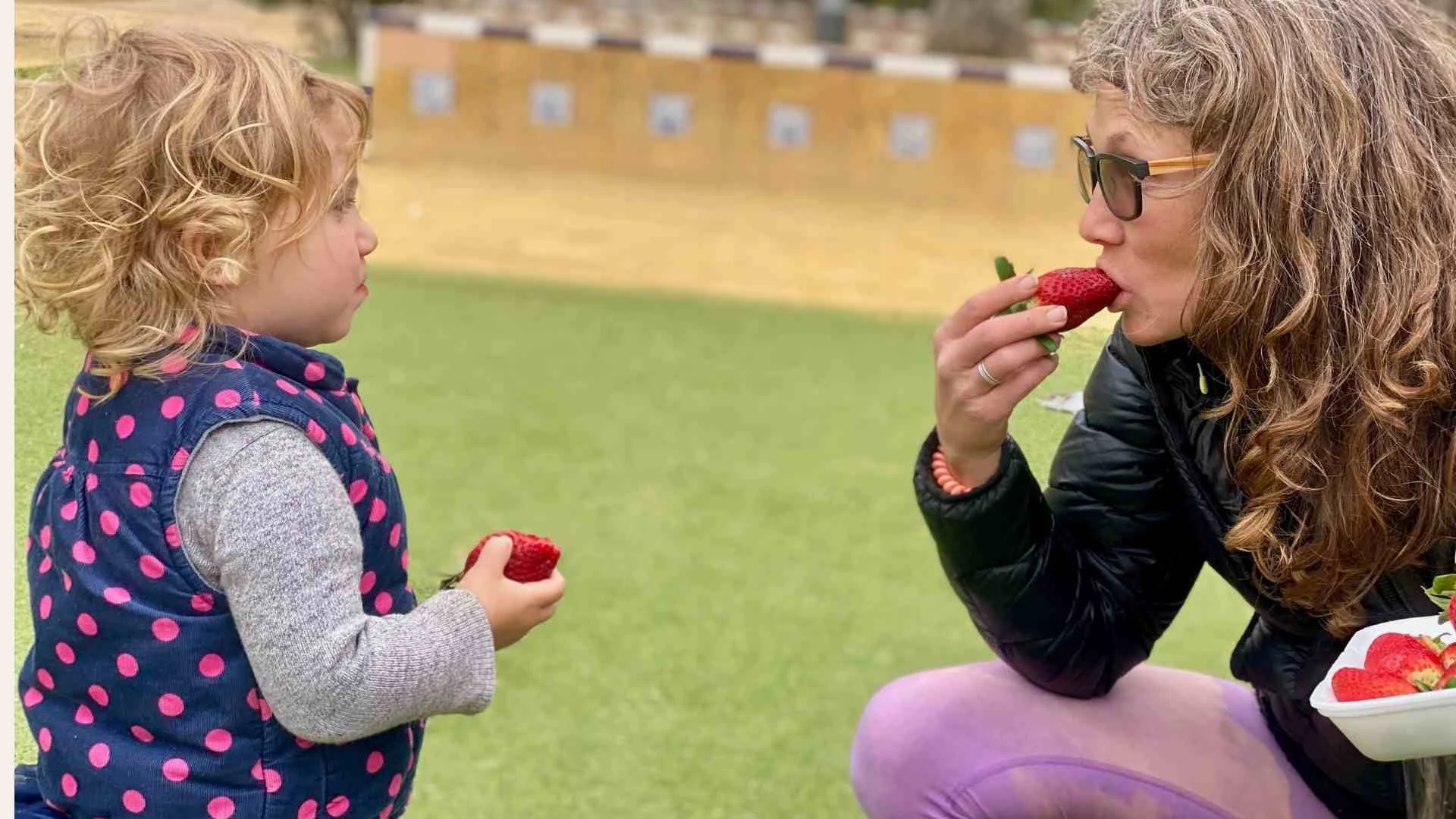
What I am working to model with my own daughter is the opposite. Body knowing, taught early, in moments small enough to land.
A few years ago we were at Burning Man. My daughter was about six. We make a point to not restrict her food, especially when we are out of the house, because restriction creates rebellion. She can have pretty much whatever she wants. At one point she came to me with a real bellyache, and when I asked her what she had been eating, the answer was cookies and a lot of processed food. Her tummy was hurting. She looked at me and said, “will you help me?”
A couple of days later she walked over with a muffin in one hand and the box it came in in the other. She held both up and asked, “can I have this?” I asked her back: “are you asking if you’re allowed, or are you asking how it’s going to make your tummy feel?” She paused, looked at the box, and said, “how’s it gonna make my tummy feel?”
That was the moment I saw it land. She was learning to read her own body. She was building body knowing at six.
This is why I do this work. Yes, partly so you can have the health you want and the healthy relationship with food you want, because health matters and quality of life is real. And more importantly, so the rules-against-the-body pattern you grew up inside doesn’t get handed forward, and your kids inherit a parent who is doing the work of listening to their own body again.
“Embody the values you want your kids to inherit.” — Chandra Zas
Frequently Asked Questions
What is a healthy relationship with food, in one sentence?
A healthy relationship with food is one where your food choices are guided primarily by your body’s cues (your hunger cues, fullness cues, energy, mood, and how a meal makes you feel two hours later) instead of by rigid rules, restrictive diets, or guilt about what you ate yesterday.
Where does emotional eating belong in this work?
Emotional eating is one of the most common patterns I see in the people building a healthier relationship with food. It is not a separate diagnosis to be afraid of; it is a coping move your nervous system practiced because nothing else was on offer. A healthy relationship with food makes room for that pattern, names it honestly, and replaces it (slowly) with body-first practices that meet the underlying need without the override. The deeper treatment of emotional vs physical hunger lives in emotional eating vs physical hunger.
What is the difference between a healthy and an unhealthy relationship with food?
A healthy relationship with food is flexible, body-led, and includes a wide variety of foods without strict rules or fear. An unhealthy relationship with food is rigid, rule-led, and built on restriction, shame, and food-as-control. The same person can move between the two; most of us have lived in both at different points, for a variety of reasons.
How long does it take to develop a healthy relationship with food?
In my four-month Food and Mood coaching program, the first two months are the mood and nervous-system regulation work, which has to come before food strategy will hold. We do not focus on food changes until the food reset starts around month three. That is when clients regularly notice big shifts in symptoms like bloating, brain fog, and energy after meals. Deeper repair (letting the body recalibrate, the gut microbiome rebuilding, food intolerances easing) runs longer than the four-month container. For more serious cases, the deeper repair can take up to two years. One of my clients, Devin, put it this way after the foundation work landed: “The more I take care of myself, the more fun business is — the less cleanup I have.”
Where should I start?
Start with the body check practice above. Then read the Mood Before Food methodology for the full framework, and the broader food psychology field for the layer it sits inside. My chapter Come Home to Your Body Wisdom lives in Chapter 0 of the Handbook for Human Potential.