
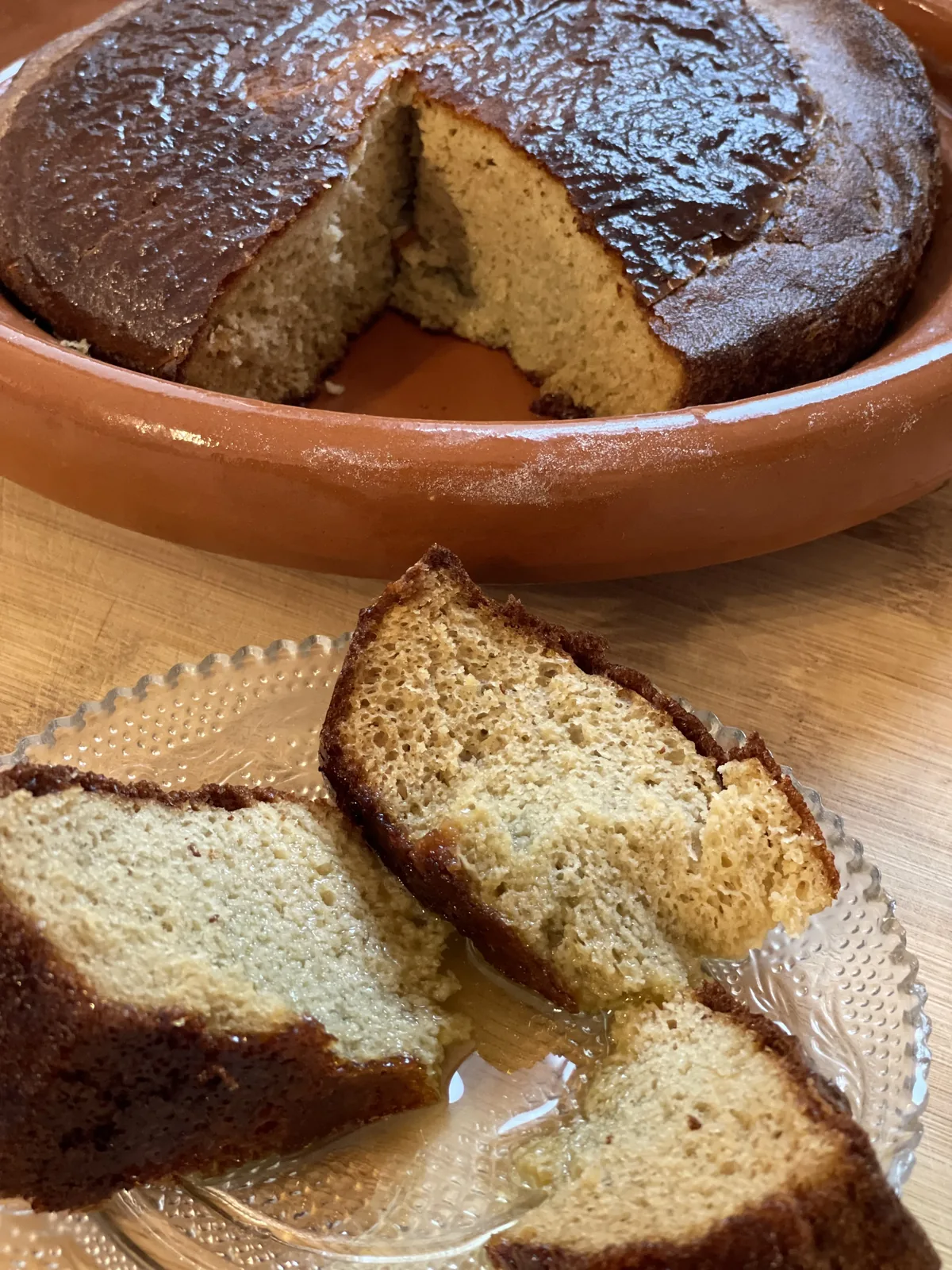
My cousin-in-law in Brooklyn — Jewish, a stellar hostess — made me this bread the first time I tried it. I was surprised at how good it tasted. No flour, no rise time, no fuss. Just tahini, eggs, honey, and a few minutes in the oven.
Fast forward a couple of years to me hunting for fun and healthy recipes for my three-year-old — and this bread came back into my life with a vengeance. She loves it. It’s become a new addition to our typical soft-boiled egg breakfast, and one of the few baked goods I keep in regular rotation.
The recipe is simple enough that you can have it in the oven in five minutes. It’s grain-free, gluten-free, refined-sugar-free, and built on real ingredients you can pronounce. It’s the kind of recipe that doesn’t ask you to give anything up.
Why this bread works without flour
Most flourless breads lean on almond flour or coconut flour — which are technically not wheat, but they’re still flours. This one uses none. The structural backbone is tahini (creamy, high-fat, high-protein) plus eggs (the binder and the leavening assist), with baking soda + apple cider vinegar doing the lift. That’s it. Five ingredients, no fillers, no gums, no flours of any kind.
What you get is a tender, sliceable bread with a nutty depth and a soft crumb. It’s not a sandwich bread — don’t expect a fluffy white-bread substitute. It’s its own thing: a savory-leaning tahini bread that pairs beautifully with eggs, olive oil, butter, soups, and sweet or savory toppings alike.
The tahini brand matters — a lot
The single most important variable in this recipe is the tahini you use. American supermarket tahini tends to be dry, gritty, or separated — and if your tahini is like that, the bread will be too.
You want smooth, creamy, pourable tahini that flows freely from the jar. The one I keep in my kitchen for this bread, salad dressings, and everything else is Lebanon Valley Tahineh — a Middle Eastern import, smooth and pourable, never bitter. The taste difference is night and day.
If you’ve never had truly fresh tahini, this recipe is worth buying one good jar to taste the difference. You’ll never go back.
My Russian mother-in-law’s trick for the baking soda
My Russian mother-in-law taught me this and I haven’t made the bread any other way since. Before adding the baking soda to the bowl, dissolve it in a teaspoon of apple cider vinegar first and let it bubble and fizz for about 30 seconds.
What it does: it neutralizes the baking-soda taste that can creep into the finished bread, and it activates the leavening reaction before the batter hits the heat, which gives you a more even rise. The bread comes out with no metallic aftertaste and a better crumb.
It’s a small extra step. It makes a big difference. I will not bake this bread without it.
Two formats — loaf or flatbread
We’ve made this both ways, and they’re both good for different reasons:
- Small bread loaf pan — gives you sliceable bread, the kind you can stack with eggs or smear with butter and honey. Slightly thicker, more substantial. Best when you want bread-bread.
- Cookie sheet flatbread — pours into a thin layer across an entire cookie sheet and gives you a really nice flatbread texture. Crisper edges, faster to cool, easier to break into pieces for dipping. This is our usual move.
If you have time, the loaf is the more “bread” experience. If you’re feeding a crowd or want it ready in five minutes, the flatbread wins.
Two batches beat one doubled batch
This is one of those counterintuitive baking notes that took me a while to figure out. Two single batches, divided onto two pans, give you a better bread than one doubled batch in a bigger pan.
When you double the recipe and pour it into a larger pan, the center doesn’t cook through evenly and the texture suffers. When you make two single batches and divide them across two pans (two loaf pans, two cookie sheets, or one of each), each one bakes evenly and the result is consistently better.
When we’re making enough for a few days, we mix two separate single batches and bake them at the same time. Same total bread, much better texture.
A note on the honey
Even if you’re someone who uses very little sweetener, this recipe needs at least the small amount of honey called for. Without it, the texture and bitterness of the bread don’t quite land. A half tablespoon for a single batch is the minimum — it’s not there to make the bread sweet, it’s there to balance the slight bitterness of the raw tahini and to help the crust set.
If you want a sweeter bread (for dessert or a kid-leaning snack), you can go up to a full tablespoon for a single batch. Beyond that the bread starts to brown too fast.
Ways to eat it
A few of the ways this bread shows up in our kitchen:
- For breakfast, alongside soft-boiled eggs with olive oil — the egg yolk on warm tahini bread is one of the best simple meals I know.
- As a kid snack — my three-year-old will eat this plain, dipped in olive oil, or with a thin smear of honey. It’s one of the rare baked goods I don’t have to think about handing her.
- With soup — a slice of this on the side of a bowl of broth or a hearty stew turns the meal into something substantial.
- As an appetizer for guests — sliced thin, drizzled with olive oil and flaky salt, served warm. It’s always a conversation starter (especially when people find out there’s no flour).
- Toasted next day — a few seconds in a hot pan or under the broiler brings back the warmth and gives the edges a little extra crisp.
Best-overs
This bread stores beautifully. Airtight container at room temperature for 2–3 days, or in the fridge for up to a week. To revive a slice that’s been refrigerated, warm it in a low oven (300°F for 5 minutes) or in a hot dry pan for a few seconds per side. It also freezes well — slice first, freeze flat, then toast straight from frozen.
Recipe
Flour-Free Tahini Bread (Flourless Tahini Bread)
Prep: 5 min · Cook: 10 min · Total: 15 min · Yield: 1 small loaf or 1 flatbread (about 8 slices)
Ingredients
- 6 tablespoons high-quality tahini (brand matters — see notes above)
- ½ tablespoon raw honey
- 4 large eggs
- 1 teaspoon baking soda, dissolved in 1 teaspoon raw apple cider vinegar
- Pinch of sea salt
- Fresh rosemary, to sprinkle on top before baking (optional but recommended)
- Olive oil, ghee, or grass-fed butter — for greasing the pan and for dipping after baking
Instructions
- Preheat the oven to 350°F (180°C).
- In a small dish, dissolve the baking soda in the apple cider vinegar — it will bubble and fizz. Wait until the fizz settles (about 30 seconds).
- In a mixing bowl, combine the tahini, honey, eggs, dissolved baking soda mixture, and salt. Whisk together until smooth and uniform.
- Grease a small loaf pan (for a bread loaf) OR a cookie sheet (for a flatbread) with olive oil, ghee, or grass-fed butter. Alternatively, line with parchment paper.
- Pour the batter into the prepared pan (loaf or cookie sheet).
- Sprinkle the top with fresh rosemary.
- Bake for about 10 minutes, or until a fork inserted comes out clean and the top is lightly golden.
- Slice and serve warm with olive oil, ghee, or butter for dipping.
To make a double quantity, mix and bake two separate single batches (one in each pan) rather than doubling the recipe into one larger pan — the texture is consistently better.
A final note
The first time I made this in my own kitchen, I couldn’t believe how easy it was. Five ingredients, five minutes of mixing, ten minutes in the oven, and we had warm bread on the table. That’s the kind of recipe that earns a permanent spot in the rotation — easy enough to make on a Tuesday, good enough to bring to a Sunday brunch, gentle enough to feed a three-year-old.
If your tahini is good and your mother-in-law’s baking soda trick is in your back pocket, you cannot mess this up. Make it once. You’ll see.
Until next time, have a beautiful day.
— Chandra Zas