
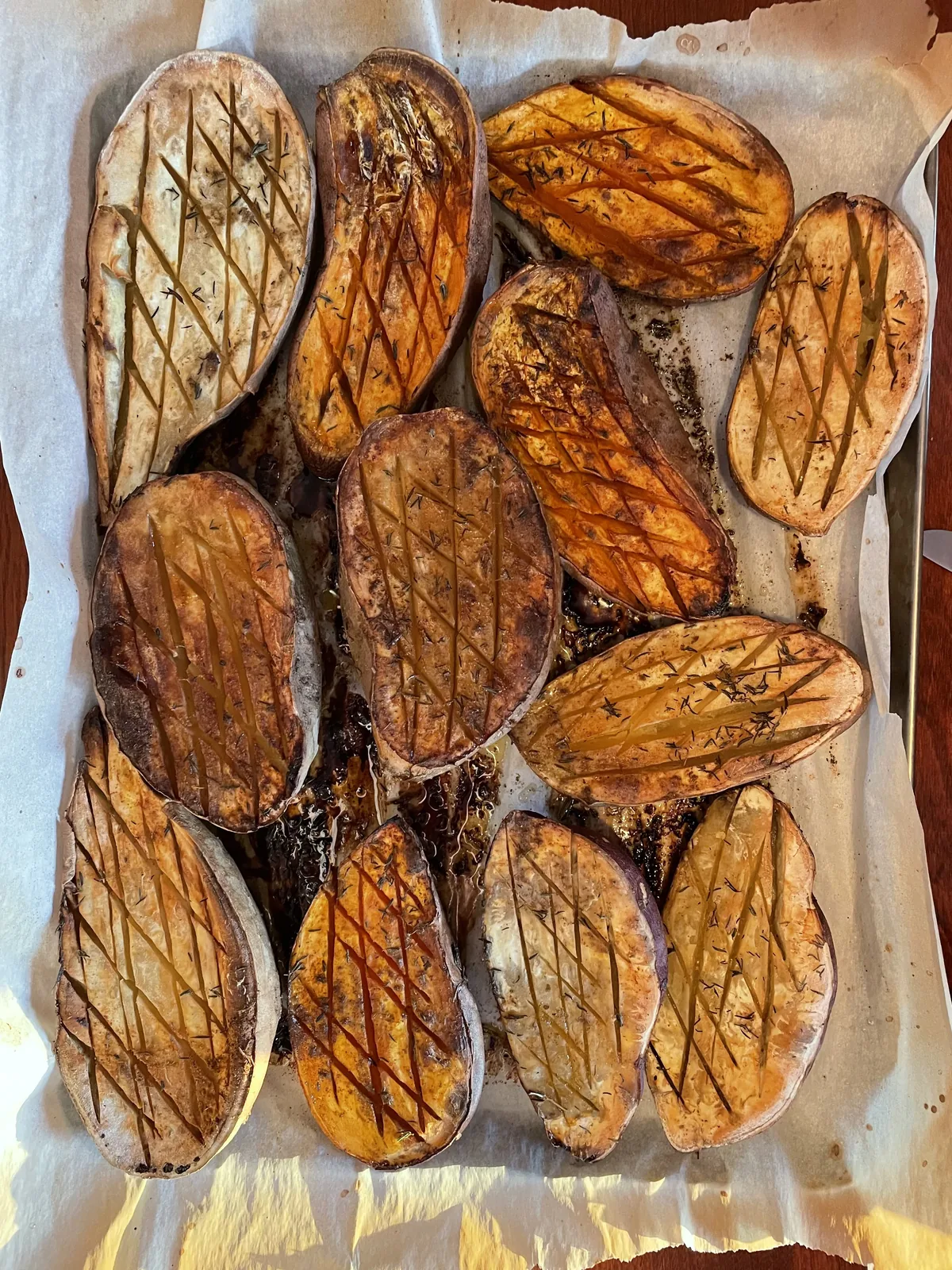
This is the recipe friends ask us to bring to every dinner. The first time we made these for our most recent crew in Reno, three different people asked for the recipe before dessert. The next time, someone said it out loud at the table: how do you make sweet potatoes that melt in your mouth like this?
The honest answer is time. We started making them this way after experimenting with every roasting method I could find, and the version that won — by a landslide — is the slow one. Three hours at a low oven, halved or in long quarters, flipped every hour with the parchment paper underneath to redistribute the oil. That’s the secret. You can speed it up when you need to (two more methods below), but if you want the melt-in-your-mouth version, give it time.
Why orange foods are a gift for digestion
Orange foods — sweet potatoes, butternut squash, carrots, pumpkin — are some of the gentlest, most digestible carbs you can put on your plate. They’re soft on the gut lining, rich in beta-carotene, and slow-burning enough to keep blood sugar steady for hours. In our house, sweet potatoes are the rotating side dish at least three nights a week.
An honest note: when sweet potatoes aren’t medicine
I want to name something most recipe blogs skip. Orange foods like sweet potatoes are deeply healing for most bodies, most of the time — but if you’re in a microbiome imbalance or actively cleansing, the high glucose load can feed the unfriendly bacteria you’re trying to starve out. In those phases, these may not be the medicine your body needs.
Listen to your body. If you’re in a cleansing phase, lean on lower-glycemic vegetables instead — cruciferous greens, summer squash, asparagus — and come back to sweet potatoes once your microbiome is more balanced. Food is contextual. The same dish that’s medicine one season can be a setback the next.
Sweet potato quality matters
The same recipe with mediocre sweet potatoes won’t deliver the body-cellular satisfaction. Look for organic, dense, evenly-shaped sweet potatoes with smooth skin and no soft spots. Our favorites come from our local food co-op, sourced from local farmers — they’re sweeter, denser, and roast better than anything we’ve ever gotten at a chain grocery store. If you have a farmer’s market, ask which growers are bringing them; the difference shows up on the plate.
Three ways to roast them — pick your time
The recipe card below features my ideal method. Here are the variations for when life moves faster:
1. Low-and-slow (3 hours, 350°F) — the melt-in-your-mouth version
This is the one our friends keep asking about. Halved or cut into long lengthwise quarters, slathered with olive oil or tallow, generous curry powder, salt. Start face-up for the first hour. At the 1-hour mark, take them out, redistribute the oil, and flip face-down for the second hour. At the 2-hour mark, flip back face-up for the final hour. The face-down middle hour caramelizes the cut surface so deeply it goes almost mahogany; the face-up hours let the skin crisp and the flesh tenderize. This is the version worth planning your afternoon around.
2. Mid-pace (2 hours, 375°F) — when you have most of an afternoon
Same cut (halves or lengthwise quarters), same up-down-up pattern but compressed: face-up for the first 40 minutes, face-down for the middle 40, face-up for the final 40. Not quite as melting as the 3-hour version, but still tender, deeply caramelized, and absolutely worth doing on a regular weeknight.
3. Sweet potato chips or fries (1 hour, 425°F) — when dinner’s in an hour
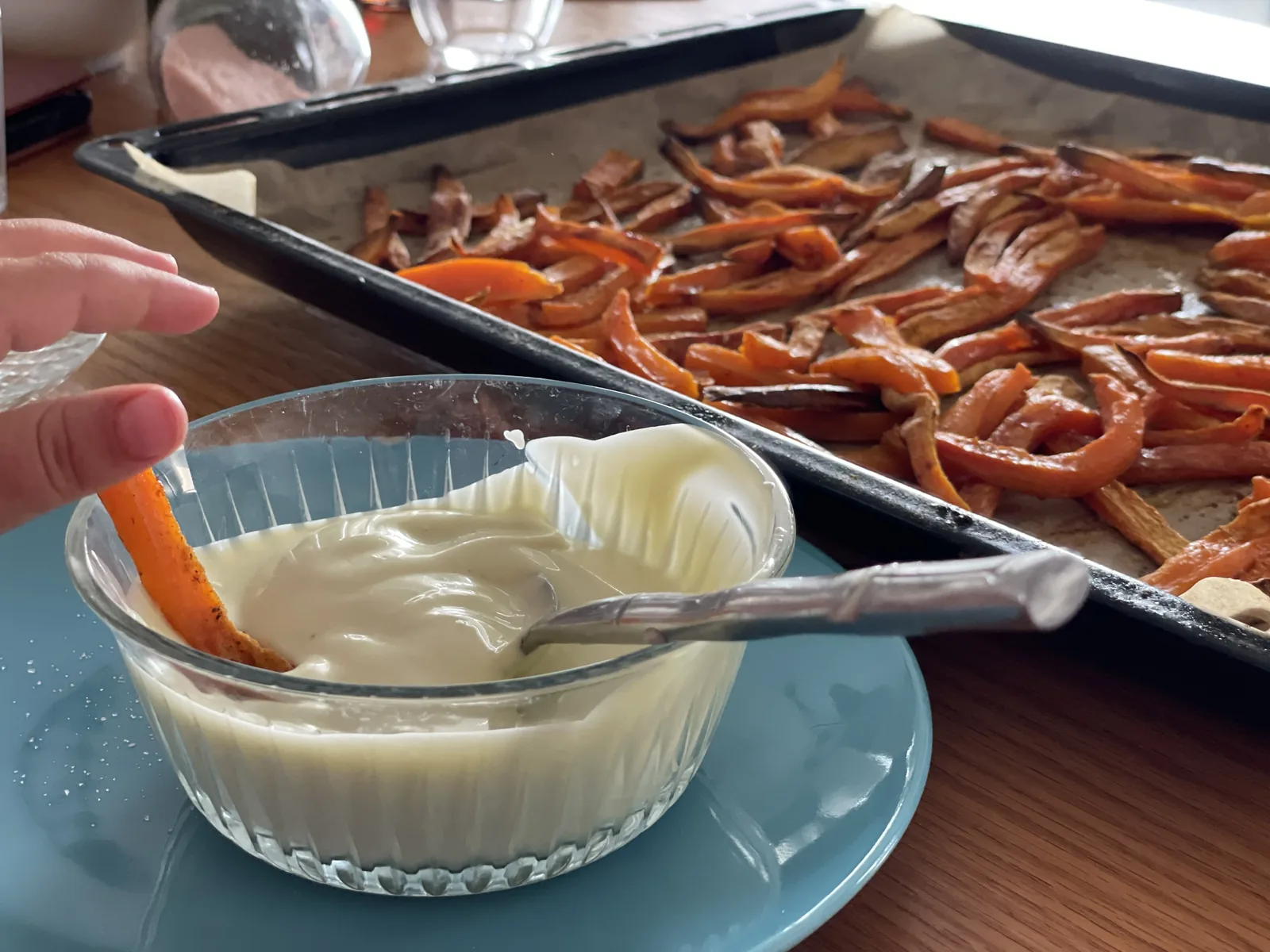
When time is short, we call them chips or fries and cut them much smaller — thin wedges or rounds about ¼-inch thick. 425°F for an hour, flipped every 20 minutes for crisp edges on all sides. Single layer matters here. Don’t double-stack the wedges on the pan — they’ll steam instead of crisp. If you’re making a bigger batch, use two sheet pans rather than crowding one. Different texture, different vibe — these are finger food, dipping-sauce food. Excellent with our homemade avocado oil mayo.
The parchment paper trick
One of the biggest upgrades to this recipe was switching to parchment paper. Here’s what it does:
- Easier flipping. You can use the paper itself to slide and lift the potatoes, redistributing them without scratching the pan or breaking the cut surface.
- Oil redistribution. Each time you flip, the paper picks up the pooled oil and re-coats the potatoes — no extra brushing needed.
- Cleanup is nothing. You crumple the paper and the pan is already clean.
The brand we use is an unbleached, all-natural, plant-based baking paper — no chemical coatings, no bleach residue. I keep a roll in the kitchen at all times. Here’s the one I buy on Amazon — If You Care parchment.
Curry — my newest favorite spice
I’ve been cooking with a lot more curry powder lately and I keep coming back to it on sweet potatoes. There’s something about the warmth of the curry against the caramelized sweetness that hits exactly right — earthy, warming, just a little floral. Go heavier than you think; a teaspoon or two across four halves disappears into the sweetness more than you’d expect.
If you’re new to curry as a spice, start with a good Madras blend or a mild yellow curry powder. Add a pinch of turmeric and a few grinds of black pepper to wake the curry up. You’ll know after one tray why this is on regular rotation.
The simple salad that turns them into a meal
A whole roasted sweet potato is a complete carb source. Pair it with a quick gut-friendly salad and you have a meal:
- A generous handful of arugula
- A spoonful of raw sauerkraut
- Thinly sliced red onion
- A drizzle of good olive oil
- A spoonful of tahini
- A sprinkle of dulse seaweed flakes
- Sea, mountain, or river salt to finish
The kraut + dulse + tahini combination does a lot of work — fermentation, minerals, and good fat in three quick scoops. Toss the arugula and onion with the oil and salt first, then dollop the tahini and kraut on top so they don’t get pulled apart by the tossing.
Best-overs
“Best-overs” is what we call next-day leftovers in our kitchen — because the second-day version is often better than the first. Sweet potatoes are the perfect example. Roast a double batch on a Sunday afternoon and you have the base of your meals for the next three days.
To reheat, we love three methods:
- On the grill alongside burgers or steak — they pick up beautiful smoky edges.
- In a cast-iron pan on the stove with a little extra olive oil or grass-fed butter — gets the caramelized edges going again.
- Packed for lunch in a glass container — they’re great at room temperature, no reheat needed.
We don’t use the microwave — it kills the texture. Other ways the leftovers show up: chopped into a breakfast hash with sautéed greens, or mashed with ghee as a side.
Recipe
Roasted Sweet Potatoes — Whole or Cut
Prep: 5 min · Cook: 3 hr (low-and-slow) · Total: 3 hr 5 min · Yield: 4 servings
Ingredients
- 4 medium organic sweet potatoes, scrubbed (skin on)
- About 1 tablespoon good olive oil per medium potato (or grass-fed tallow — spreads beautifully on the cut surface)
- Sea, mountain, or river salt, to taste
- Optional: 1–2 teaspoons curry powder per cut half (Simply Organic curry powder and Simply Organic spicy curry are both excellent)
- Optional: cumin, turmeric, or smoked paprika
- Optional: fresh rosemary or thyme sprigs (oil these too)
Instructions
Low-and-slow (3 hours, 350°F — the melt-in-your-mouth version)
- Heat the oven to 350°F. Line a sheet pan with unbleached parchment paper.
- Cut the sweet potatoes in half lengthwise — or, for a faster cook, into long quarters.
- Score the cut surfaces about ¼-inch deep in a crosshatch pattern.
- Slather the cut sides generously with olive oil or tallow (about 1 tablespoon per potato). Sprinkle with salt and 1–2 teaspoons of curry powder per cut half. If using fresh herbs, oil them too before placing on the pan.
- Place cut-side UP on the parchment-lined pan for the first hour.
- At the 1-hour mark, take the pan out, redistribute the oil with the parchment, and flip the potatoes face-DOWN for the second hour.
- At the 2-hour mark, flip them back face-UP for the final hour.
- They’re done when the cut surface is deeply caramelized and a fork slides through with zero resistance. The texture should melt in your mouth.
Mid-pace (2 hours, 375°F)
- Same cut (halves or lengthwise quarters), prepped the same way.
- Roast at 375°F for 2 hours total: 40 min face-up, 40 min face-down, 40 min face-up.
Sweet potato chips or fries (1 hour, 425°F)
- Cut into thin wedges or rounds about ¼-inch thick.
- Toss with olive oil and salt; spread on a parchment-lined pan in a single layer (don’t double-stack — use a second pan if you need more room).
- Roast at 425°F for 1 hour, flipping every 20 minutes for crisp edges on all sides.
A final note
This is the dish I’d put on the table if I had one shot to convince someone that healthy comfort food is real. It’s almost nothing — sweet potatoes, olive oil, salt, time. But the result is the kind of food that makes people lean forward, take a bite, and ask how. The answer is always the same. Three hours at 350°. Parchment paper. Flip every hour. Let the time do the work.
Until next time, have a beautiful day.
— Chandra Zas