
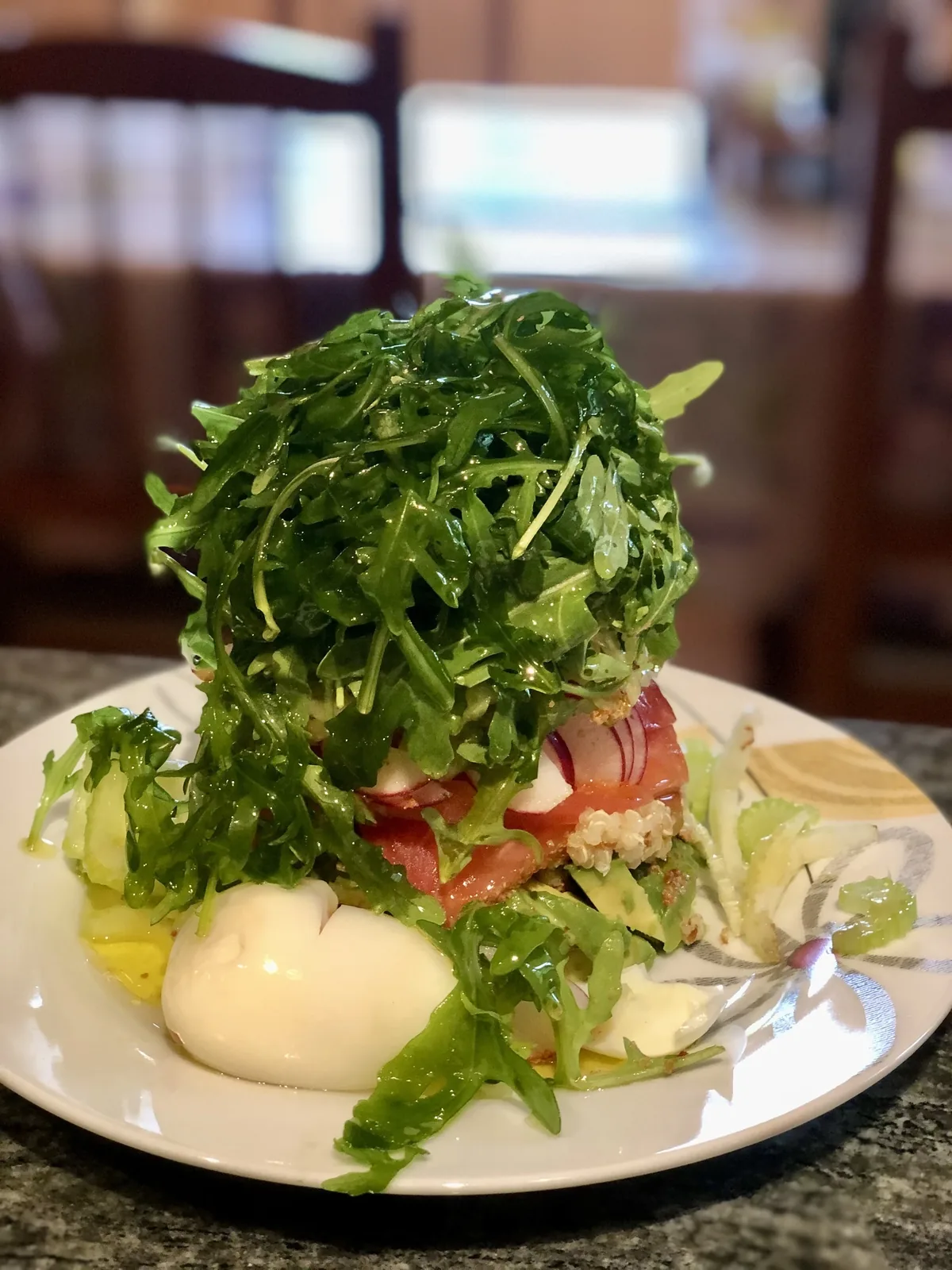
Some people call me a salad master. I don’t know about that — but I’ll say this: I’ve made a lot of salads. Years ago, I ran a raw food kitchen at BodyMind Restoration Retreats, serving 80 people two salads a day. After enough rounds of that, you stop thinking about salad as a thing to throw together and start thinking about it as a small, daily piece of architecture. What’s it for? What’s it doing in the body? What does it need to actually work?
This bowl is the answer I keep coming back to. Soft-boiled eggs, a big pile of greens, kraut, seeds, avocado, and the right acid to help the whole thing land softly in the gut. It’s my daily go-to lunch — the meal I default to when I want something fast, gut-friendly, and actually fueling.
What a good salad is actually doing in the body
I think about a salad in three buckets — fiber, digestion, and fuel. When all three are present, a salad isn’t just a side; it’s a full meal that does real work.
Fiber for keeping things moving. This is the housekeeping bucket. Greens, raw veg, kraut — the rough-age that keeps food waste moving down and out. A healthy gut needs a steady throughput, and a daily salad is one of the simplest ways to give it that.
Acid and enzymes for digesting the greens. Greens are not easy to break down. This is one of the reasons most kids don’t love raw vegetables — they don’t yet have the digestive enzymes to handle them (usually until around age seven). Adults can struggle with this too. The fix is to always include at least one digestive helper: lemon juice, raw apple cider vinegar, a high-quality balsamic, red onion, or sauerkraut. These wake up the stomach acid and the enzymes that actually unlock the nutrients in the greens. Skip them and you’ll feel heavy. Include them and the same bowl feels light. And use enough — most people under-dress this kind of salad with a half-teaspoon of lemon, a sad drizzle of oil, and a pinch of kraut. The amounts in the recipe below are minimums. More is better.
Fuel for the brain and body. This is where the calories, protein, and fats come in — eggs, olive oil, pumpkin seeds, flax, avocado, and (if you want more) tahini or hemp. Without this bucket, a salad is a snack. With it, a salad is a meal that keeps you steady for hours.
The through-line — feeding your microbiome. Every ingredient in this bowl feeds the friendly microbes living in your gut. Prebiotic fiber from the raw veg and greens, probiotic cultures from the kraut, digestive enzymes from the acid — your microbiome is fed by all of it. And a healthy microbiome is what actually does the deep work of digestion, mood regulation, and immune resilience. A daily salad isn’t just feeding you. It’s feeding the bacteria that keep you well.
An honest note: when raw greens aren’t medicine
I want to name something most salad posts skip. Raw greens, raw onion, and kraut are foundational for most bodies, most of the time — but if you’re in a phase of active gut repair, an IBS flare, a histamine issue, or a microbiome recalibration, this bowl can be a lot to ask of the system.
In those phases, lean cooked and warm: gently sautéed greens, cooked carrots and squash, well-cooked proteins, broth-based soups. Come back to the raw bowl once your gut has stabilized and your body is asking for it again. Food is contextual. The same meal that’s medicine for me on a Tuesday might be a setback for someone else that same week. Listen to your body more than you listen to any recipe — mine included.
How this whole salad comes together in 10 minutes
Here’s the selling point most salad recipes bury: this salad takes as long as the eggs to boil. Put the water on the moment you walk into the kitchen. Once it’s at a rolling boil, drop the eggs in and set a timer for seven minutes — that’s my number. At the same time, get a second pot going for the carrots: sliced thin, into boiling water, they take about seven minutes too. Thinner slices cook faster. The right doneness is when a fork slides easily through.
While both pots run, you have seven minutes to do everything else. Pull out the greens, wash and layer them in a wide bowl. Slice the cucumber, daikon, onion, and avocado on top. Pull out the kraut, seeds, dulse, and flax so they’re ready to go.
When the timer goes off, lift the eggs straight into a bowl of cold water for thirty seconds (this stops the cook and makes them peel cleanly). Drain the carrots. Top the bowl, dress it generously, and you’re eating in ten minutes flat.
Seven minutes gives me a soft, runny yolk that drapes over the greens. If you like it runnier, drop to six. If you want it more set but still creamy, go to eight. Once you find your number, the eggs become muscle memory.
How we use this bowl
This is what I make when I want lunch in ten minutes and I want it to actually fuel the afternoon. A few of the ways it shows up in our kitchen:
- Solo lunch at home — the version above, eaten standing at the counter half the time.
- Office or travel lunch — counter-intuitively, I make the whole salad at home and let it marinate for a few hours before I eat it. The greens don’t wilt; the flavors soak in. It gets better, not worse, after sitting.
- Family dinner side — scaled to four servings, eggs cooked in a bigger pot, everyone builds their own bowl.
- Post-workout meal — I double the protein (extra eggs, a scoop of hemp seeds) and add a roasted sweet potato on the side for the carb.
If you want a quieter, more minimalist version — softer on the gut, faster to make — see my soft-boiled eggs with olive oil (“Egg Soup”). Same eggs, no greens, no chewing required. That’s my sick-day version of this same instinct.
Storage and prep ahead
Salads don’t keep well dressed, but the components do. A few tricks from our kitchen:
- Hard-boil the eggs ahead. A batch of six in the fridge means lunch is three minutes away all week.
- Pre-chop greens and store in a paper-towel-lined container. They’ll stay crisp for three or four days.
- Quick-boil a few carrots at once. They keep in the fridge for a week and disappear into every salad, hash, or breakfast bowl.
- Pre-mix the dressing. If you’re using olive oil, lemon, and a pinch of salt as a stand-alone dressing, shake it in a small jar and keep it on the counter — you’ll dress everything more generously when it’s already made.
The toppings we actually use day to day — dulse flakes, sprouted pumpkin seeds, hemp seeds, ground flax, a smooth tahini, a clean extra virgin olive oil, raw apple cider vinegar or balsamic, and flaky Maldon salt — are all on my Satisfying Salad & Meal Toppings page. Buy local whenever you can (kraut especially); these are the things that don’t show up at the farmer’s market.
On the eggs: the single biggest quality lever in this bowl is the eggs themselves. We currently get ours shipped from Angel Acres Farms — regeneratively farmed, low-PUFA, the cleanest source we’ve found after years of looking. See the full egg-sourcing breakdown in my Egg Soup post if you want the deeper story.
Recipe
Soft-Boiled Egg Salad — Daily Go-To Lunch Bowl
Prep: 3 min · Cook: 7 min · Total: 10 min · Yield: 1 serving (scalable 2× or 4×)
Ingredients
- 2 organic free-range eggs
- 2 generous handfuls organic greens (lettuce, arugula, baby kale, or a mix)
- 2 medium carrots, sliced (or best-overs roasted veggies)
- 2 thin slices red onion
- 1–2 tablespoons raw sauerkraut
- At minimum 1 teaspoon ground flax seeds, refrigerated (I use closer to 1 tablespoon)
- At minimum 1 teaspoon dulse seaweed flakes (I use closer to 1 tablespoon)
- 1 tablespoon sprouted pumpkin seeds
- ¼ cucumber, sliced
- At minimum 2 thin slices daikon or 1 small radish
- ½ avocado, sliced
- 1–2 tablespoons good olive oil (don’t be shy)
- At minimum 1 teaspoon fresh lemon juice, raw apple cider vinegar, or a high-quality balsamic (more is better)
- Sea, mountain, or river salt to taste
- Optional: 1 tablespoon tahini, hemp seeds, or both for extra fuel
Instructions
- Put a small pot of water on to boil the moment you walk into the kitchen. Once it’s at a rolling boil, lower the eggs in gently and set a timer for 7 minutes for a soft, runny yolk (6 minutes for very runny, 8 for set-but-creamy).
- Start a second pot of boiling water for the carrots at the same time as the eggs. Drop the sliced carrots in — they need about 7 minutes too. The thinner you slice them, the faster they cook. They’re done when a fork slides easily through.
- While both pots run, layer the greens, cucumber, daikon or radish, red onion, and avocado in a wide bowl.
- When the timer goes off, transfer the eggs to a bowl of cold water for 30 seconds, then peel and cut in half. Drain the carrots.
- Top the bowl with the carrots, sauerkraut, flax, dulse, pumpkin seeds, and halved eggs.
- Drizzle generously with olive oil and your acid of choice — lemon juice, apple cider vinegar, or a high-quality balsamic. Finish with salt to taste. Add tahini or hemp seeds if you want more fuel.
A final note
A daily salad isn’t a virtue exercise. It’s a small, repeatable piece of nourishment that does three things at once — keeps things moving, helps you digest, and gives your body real fuel. Get those three buckets right and a salad stops being a side. It becomes the meal you reach for because you already feel better after eating it.
Until next time, have a beautiful day.
— Chandra Zas