
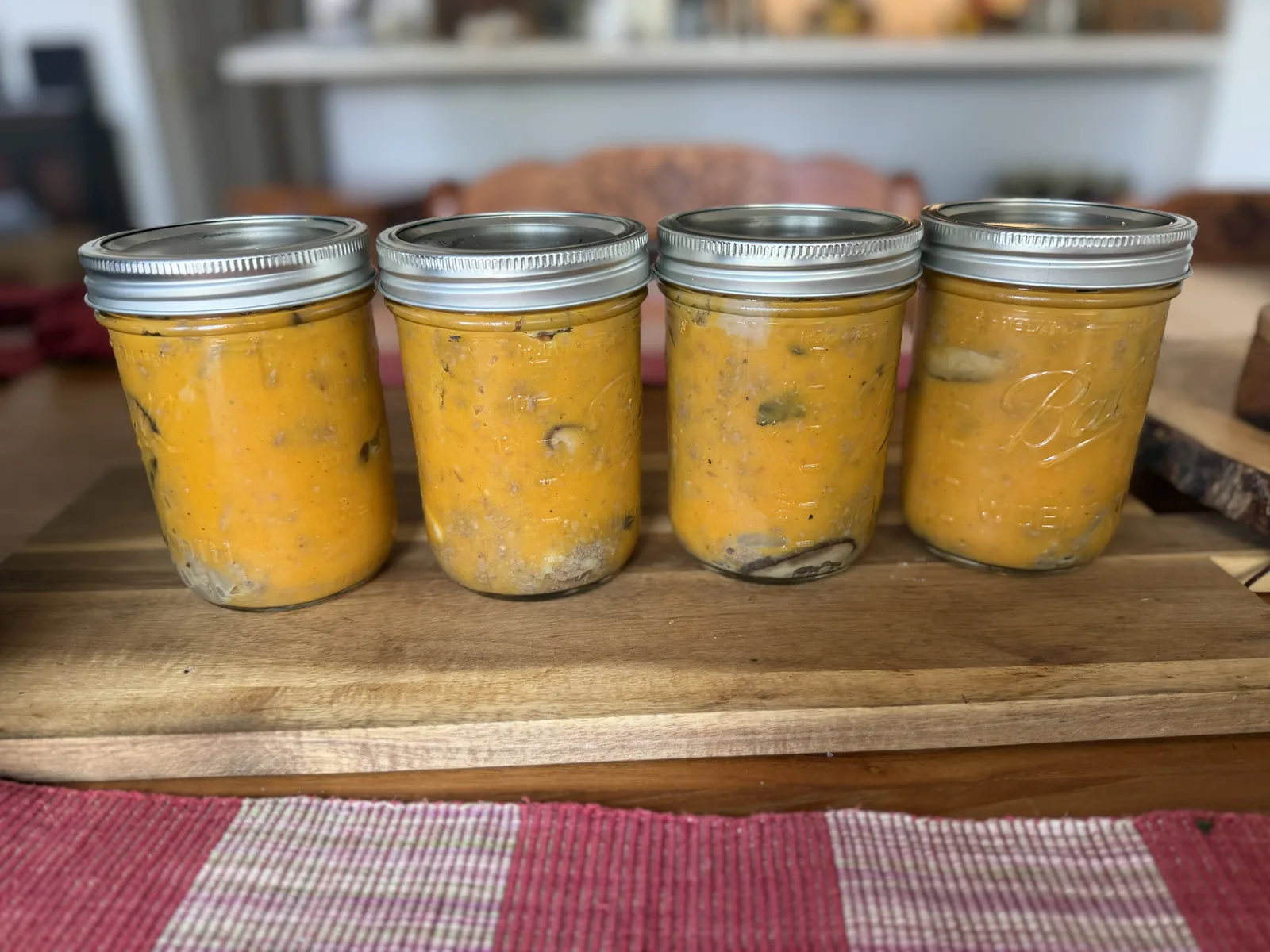
This is one of my newest favorite recipes. The combination might sound unusual until you taste it — sweet roasted butternut squash blended into a silky base, deeply spiced with curry that’s been toasted Ayurvedic-style to open its flavor, then topped with ground elk and sautéed shiitake mushrooms. It is one of the most nourishing soups I make, and one of the most satisfying.
The elk is the surprise ingredient. Ground elk is mild — closer to lean beef than to anything gamy — and it gives this soup a depth of protein that turns it into an actual meal, not just a starter. The shiitake adds umami and texture. Together with the curry-spiced squash, it’s a bowl that feeds the body in a way a vegetarian squash soup can’t quite.
Why this combination works
Every ingredient here is doing real work. This isn’t food that tastes good despite being healthy; it’s food that tastes good because of what’s in it.
- Butternut squash — beta-carotene, fiber, gentle blood-sugar carbs, and the kind of natural sweetness that doesn’t need any added sugar to satisfy
- Curry powder (toasted) — the warming spice blend (turmeric, cumin, coriander, cardamom, ginger, more) supports digestion and circulation; toasting first is an Ayurvedic technique that activates the volatile oils where the flavor and benefits actually live
- Shiitake mushrooms — immune support, B vitamins, the meaty texture that gives the soup body
- Ground elk — lean, clean wild-game protein with a higher iron content than beef and zero of the factory-farm concerns of mainstream meat
- Ghee — clarified butter, lactose- and casein-free for most people who react to dairy, with the kind of high-smoke-point fat that’s perfect for sautéing
- Celtic sea salt — my preference for this soup specifically; the mineral profile and slightly grey color tell you it’s the real unrefined thing, and the flavor lands rounder than refined sea salt
Where to find elk
If you’ve never cooked with elk before, ground elk is the easiest entry point. It behaves like ground beef in the pan, but it’s leaner and cleaner. Where we source ours:
- Force of Nature — our go-to for all meats. We buy in our local stores sometimes, but most often we order online — orders over about $150 get free shipping and a meaningful discount. Their ground elk, bison, and grass-fed beef are all clean, regenerative, and traceable. This is the recommendation I stand behind.
- Specialty butcher — if your area has one, ask. Most carry elk seasonally (October through January) or can order it for you.
- Farmers’ markets — wild-game producers often show up at fall and winter markets.
- Direct from a hunter — if you know someone who hunts (or who knows someone who hunts), this is often the cleanest, freshest source.
If you can’t find elk, you can substitute ground bison (similar wild-game profile, lean and clean) or grass-fed ground beef. Force of Nature carries both. The soup is excellent with either, though the elk is what makes it distinctly its own.
The Ayurvedic curry-toasting trick
This is the technique that makes the whole soup. Before the squash goes in, the curry powder gets toasted in the dry pot over medium-low heat for 30 to 60 seconds.
What it does: spices contain volatile aromatic oils that are released by heat. Adding them cold to a wet liquid wastes most of those oils — you get color but not the full flavor profile. Toasting briefly in a dry pan first activates those oils so you get the deep, complex, layered curry character that defines a really good spiced dish. This is a standard Ayurvedic and Indian cooking technique that I’ve adopted across multiple recipes (my Ayurvedic pesto uses the same principle with cumin).
A note on burning: 30 to 60 seconds is the window. Past that, curry powder goes from fragrant to bitter fast. Watch the pot. As soon as it smells like a curry restaurant, the squash goes in.
The salt question — Celtic sea salt
Most of my recipes use whatever good sea salt I have on hand — Maldon flakes for finishing, fine sea salt for cooking. This soup is different. I specifically use Celtic sea salt here, and it makes a difference I can taste.
Celtic sea salt is hand-harvested from the coast of Brittany, dried on clay rather than refined, and retains its full mineral profile — magnesium, calcium, potassium, plus the trace minerals that make ocean salt taste like more than just sodium. The crystal is slightly grey, slightly moist, and rounder in flavor than refined sea salt. With the sweet squash and warming spices, that mineral depth lands beautifully.
If Celtic isn’t available, any good unrefined sea salt works. Skip iodized table salt — for the same reason I do across all my recipes, the mineral profile and taste are what matter.
Variations
The soup welcomes adjustments. A few we’ve tested:
- With cream, without cream — a small splash of organic heavy cream at the end makes the soup richer and slightly sweeter; I usually skip it (the squash is already silky enough) but it’s a real upgrade for company.
- Swap butternut for pumpkin or kabocha squash — both work beautifully. Kabocha has a denser texture; pumpkin gives a slightly looser soup.
- Swap elk for ground bison or grass-fed beef — same technique, very similar result.
- Swap shiitake for cremini or maitake — shiitake is the most flavorful, but any meaty mushroom works.
- Add a tablespoon of fresh ginger with the toasted curry for extra warmth.
Ways to eat it
This soup is dinner on a cold night. The ways it shows up in our kitchen:
- In a wide bowl with a slice of warm flourless tahini bread on the side
- Topped with a spoonful of Ayurvedic pesto for a green-herbaceous lift against the warm squash
- As leftover lunch the next day — the curry deepens overnight in the fridge
- As a sick-day soup when someone needs something nourishing and warming
- With a simple side salad for a complete meal
Best-overs
This soup gets better the second day — the flavor deepens overnight as the curry and squash meld in the fridge. It keeps for up to 5 days in a sealed container, and freezes well for up to 3 months.
To reheat: warm gently on the stovetop over low heat, stirring occasionally. Add a splash of water if it’s thickened too much in the fridge. The microwave works in a pinch but the gentler stovetop reheat preserves the texture better.
Recipe
Butternut Squash Elk Soup with Shiitake
Prep: 15 min · Cook: 1½ hr (mostly hands-off squash roasting) · Total: about 1¾ hr · Yield: 8 servings
Ingredients
- 1 large or 2 medium butternut squash (to yield about 10 cups roasted flesh)
- 2 tablespoons yellow curry powder (for 2 medium squash — adjust to taste)
- 1 pound ground elk
- 2–3 cups sliced shiitake mushrooms (about 8 oz fresh)
- 2–3 tablespoons ghee, divided (for the mushrooms and the elk)
- 1 tablespoon Celtic sea salt (or to taste — Celtic is what I use for this one)
- ½ teaspoon freshly ground black pepper, for the elk
- Water, to thin to your preferred consistency (start with 2 cups, add more as needed)
- Optional: a small splash of organic heavy cream at the end (I usually skip it)
Instructions
- Roast the squash whole. Place the whole butternut squash on a baking sheet and roast at 375°F (190°C), rotating every half hour or so, until the skin is wrinkled and a knife slides through with zero resistance — about 60 to 90 minutes depending on size. (I often cook this alongside other roasted vegetables to fill the oven.)
- Let the squash cool until you can handle it, then cut in half, scoop out the seeds (discard or save for roasting separately), and scoop the flesh into a large pot. You’re aiming for about 10 cups of cooked flesh.
- Toast the curry. Set the pot over medium-low heat (push the squash aside if it’s already in). Add the curry powder to the dry pot and toast for 30–60 seconds, stirring constantly, until fragrant.
- Add the squash to the pot with the toasted curry. Use an immersion blender to blend until smooth.
- Add water gradually to thin to your preferred consistency — start with 2 cups, add more for a thinner soup. Add the Celtic sea salt and stir.
- Sauté the mushrooms. In a separate skillet, melt about 1 tablespoon of ghee over medium heat. Add the sliced shiitake, season with a pinch of salt, and sauté until golden and tender — about 5 to 7 minutes. Transfer to a plate.
- Cook the elk. In the same pan (no need to wipe), add another 1–2 tablespoons of ghee. Add the ground elk, break it up with a spoon, and cook until browned through — about 8 to 10 minutes. Season with salt and pepper as it cooks.
- Combine. Add the cooked shiitake and the cooked elk to the pot of blended butternut squash soup. Stir to incorporate and heat through over low heat for 5 minutes.
- Taste and adjust salt. The soup should taste warming, deeply spiced, savory.
- Optional: stir in a small splash of heavy cream right at the end for a richer texture (skip for dairy-free).
- Serve hot in wide bowls.
For a fully dairy-free version, substitute olive oil or coconut oil for the ghee. (Ghee is technically clarified butter — most dairy-sensitive people tolerate it, but if you’re strictly dairy-free, the oil swap works perfectly.)
A final note
This soup is one of the recipes I came to slowly — testing combinations, discovering that elk and shiitake belong together, learning that toasting the curry before the squash makes the whole bowl bloom. It’s the kind of dish that gets better every time I make it because I keep finding small adjustments that deepen it.
If you’ve never cooked with wild game, this is a beautiful entry point. The elk is mild, the squash carries the flavor, and the curry does the heavy lifting. Make it once. You’ll see why it’s on permanent rotation in our kitchen.
Until next time, have a beautiful day.
— Chandra Zas