
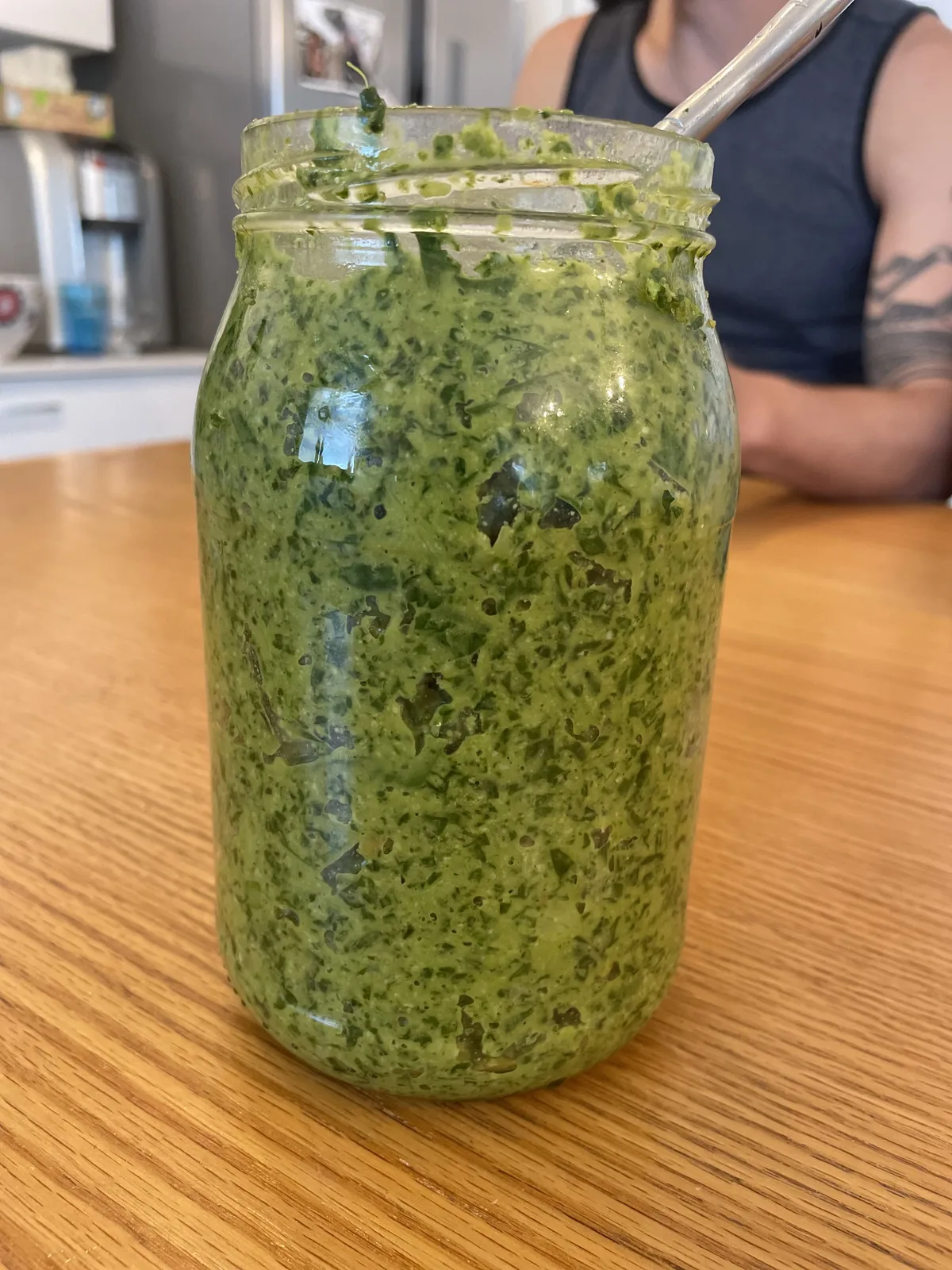
I was introduced to this pesto by Dianna of the Dhyanna Center when I attended her Ayurvedic course back in 2012 and 2013. She called it medicinal food, and that framing has stayed with me ever since. The recipe is packed with greens, olive oil, warming spices, and garlic — every single ingredient is doing real work for the body. It is genuinely medicine in the form of food.
I made this pesto on regular rotation for a year before I moved to Israel. It was one of the foods I brought with me to Burning Man in 2014 — the same Burning Man where I met my Man. Then it slipped out of my life for a few years, and I am very happy to have it back in full force. For the last while we’ve been making a big batch about twice a month, and it lasts us about ten days. My three-year-old asks to lick the spatula full of pesto the same way I licked spatulas covered in cake batter when I was a kid.
Happy food dancing is inevitable with this pesto. Everyone who has shared it in our home has had a satisfied moan — even my little one’s great-grandma, who doesn’t believe in vegetables, lights up when she tastes it. That, in itself, is medicine.
Why this is medicinal food, not just a sauce
Traditional Italian pesto is a beautiful dish — basil, pine nuts, garlic, salt, olive oil, hard cheese. This version takes the bones of that recipe and rebuilds it through an Ayurvedic lens, where every ingredient earns its place by what it does in the body.
- Basil, cilantro, and parsley — chlorophyll-rich greens that support detoxification, alkalize, and bring real plant-medicine punch. Cilantro in particular is known in Ayurveda for moving heavy metals out of the body.
- Garlic — antimicrobial, immune-supporting, warming for circulation. Five cloves is not too many.
- Cumin — one of the most digestion-friendly spices in the Ayurvedic apothecary. It stimulates digestive enzymes and helps the body break down the rich olive oil + greens combination.
- Leek — gentle prebiotic fiber, feeds the gut microbiome, adds a savory base note without the bite of raw onion.
- Lemon (with the rind) — vitamin C from the flesh, and bioactive compounds from the peel that support liver function and add a bright, lifting flavor.
- Pine nuts, pecans, or sprouted pumpkin seeds — the fat and protein backbone. Use them raw or dry-roasted (never roasted with seed oils). Roasting brings out more depth; raw keeps more enzymes intact. Both work beautifully.
- Olive oil — a lot of it — extra-virgin olive oil is one of the most healing fats on the planet. The oil also carries the fat-soluble medicinal compounds from the herbs and spices into your body. Generous oil isn’t an indulgence here; it’s the delivery mechanism.
When you eat this pesto, you are taking in concentrated greens, warming digestive spices, antimicrobial garlic, prebiotic leek, and healing fats — all in one spoonful. That’s why it feels so satisfying after just a couple of bites. Your body recognizes what’s coming in.
Why no cheese
Traditional pesto leans on Parmigiano-Reggiano or Pecorino for the umami depth. This version skips it for three reasons: it makes the pesto fully dairy-free (so anyone can eat it), it keeps the recipe shelf-stable longer (no dairy to go off), and the cumin + garlic + leek + lemon-rind combination delivers a savory complexity that doesn’t ask for cheese to be complete. You will not miss it.
If you want a cheesy hit, sprinkle a little nutritional yeast on top when serving — I do this sometimes for my daughter. But the base recipe stands on its own.
”Feel the food” — the improvisational method
When Dianna taught this recipe, she didn’t give exact amounts. The phrase she used — and the one I’ve used ever since — is feel the food. The ratios in the recipe card below are starting points; once you’ve made it a few times you’ll find your own rhythm.
Use a food processor if you have one. This recipe is definitely better in a food processor than a blender — the S-blade handles the dense base and the volume of greens way more efficiently. A blender works in a pinch, but you’ll have to stop and scrape much more often, and the texture won’t be quite as silky. If a food processor is the kitchen upgrade you’ve been considering, this is one of many recipes that earns it back.
The two principles to trust:
- More olive oil than you think. Pesto in this style is supposed to be rich. If your blender is struggling, the answer is more oil. If the pesto feels dry on the spoon, the answer is more oil. If it tastes flat, often the answer is more oil and a little more salt.
- Blend the base before the greens. The base ingredients (nuts, garlic, salt, cumin, oil, lemon, leek) need to be thoroughly broken down first — to nut-butter consistency — before you start adding the greens. The smoother the base, the better the final texture. Then add the greens in batches, slowly, with extra oil whenever the blender asks for it.
The olive oil seal — how to keep it fresh
This is the storage trick that takes the pesto from “use within three days” to “good for a week or longer.” Every time you scoop pesto out of the jar, flatten the surface with the back of a spoon and pour a fresh thin layer of olive oil on top before putting it back in the fridge.
What the oil cap does: it blocks oxygen from reaching the pesto, which is what causes it to brown and go off. Done consistently, this lets the pesto hold for 7–10 days easily. We sometimes push it past that.
Organic greens — non-negotiable
I always use all-organic ingredients for this pesto, and the greens are the most important. Non-organic basil, cilantro, and parsley are often heavily sprayed — the leaves’ surface area is enormous, and the residues don’t wash off. If there’s one ingredient in this recipe to splurge on organic, it’s the greens. (Garlic and lemon-with-rind are second on that list.)
A note on raw garlic — give it 24 hours if you’re sensitive
Five cloves of raw garlic is real medicine. It’s also a real bite on day one — my daughter sometimes finds it too spicy the first day, and adults with sensitive guts can feel the same. The fix is simple: make the pesto a day ahead and let it sit in the fridge for 24 hours before eating. The raw-garlic edge mellows beautifully, the flavors marry, and the kid-and-sensitive-gut crowd gets to enjoy it too. We often make a batch the day before we want it for exactly this reason.
Ways to eat it
This pesto is the workhorse condiment in our kitchen. A few of the ways it shows up:
- Stirred into scrambled eggs at the end of cooking — instant flavor and a green-on-yellow plate that feels like a celebration
- Spooned over roasted sweet potatoes — the warm caramelized sweet potato + cool herbaceous pesto combination is one of the best simple meals I know
- Slathered on warm flourless tahini bread — tahini + pesto + a drizzle of extra olive oil
- On top of baked salmon or other fish — spoon a generous tablespoon over the fillet in the last 2 minutes of cooking, or serve cold on top
- As a dressing for soft-boiled egg salad — thin with a splash of lemon juice and use in place of the standard olive-oil-and-vinegar drizzle
- Stirred into rice, quinoa, or other cooked grains — turns a plain grain into a meal
- As a dip with raw vegetables — carrot sticks, cucumber slices, sliced bell peppers, endive leaves
Best-overs
This pesto stores beautifully. Refrigerated in a clean glass jar with the olive oil seal, it keeps for 7–10 days easily. For longer storage, freeze in small batches — ice cube trays work beautifully, then transfer the frozen cubes to a freezer bag. A frozen cube dropped into a hot pan of vegetables or pasta water is one of the fastest ways to bring this recipe back to life on a weeknight.
Recipe
Ayurvedic Pesto (Medicinal & Dairy-Free)
Prep: 25 min · Cook: 5 min (dry-roasting the nuts) · Total: 30 min · Yield: about 4 cups (lasts about 10 days in our house)
Ingredients
- ½ cup pine nuts, pecans, or sprouted pumpkin seeds (raw or dry-roasted — never roasted with seed oils)
- 5 cloves garlic, peeled (chopped if using an immersion blender)
- 1–2 tablespoons cumin (I go heavier than a tablespoon — for flavor and digestion)
- 2 teaspoons sea salt (generous, to taste)
- 1 cup extra-virgin olive oil, divided — ½ cup for the base, ½ cup for blending the greens, plus extra as needed and for storage
- ½ whole lemon, cut and de-seeded — include about ¼ of the lemon rind
- 1 leek, the 5-inch white section at the bottom (no green tops)
- 5 bunches greens — about 8–10 cups loosely packed leaves; basil as the base, plus cilantro and/or parsley
Instructions
- Optional: dry-roast the pine nuts, pecans, or sprouted pumpkin seeds in a skillet over medium-low heat, stirring often, until lightly golden and fragrant — about 5 minutes. No oil. (Raw works too — both ways are great.)
- Blend the base ingredients first. In a food processor (preferred), Vitamix, or immersion-blender jar, combine the nuts/seeds, peeled garlic, salt, cumin, ½ cup olive oil, lemon (flesh + rind), and the white section of the leek. Blend until the consistency is smooth, like a nut butter.
- Add the greens in batches. Start with about a third of the basil and any cilantro and/or parsley you’re using. Blend, stopping to scrape down the sides. Drizzle in more olive oil whenever the blender struggles.
- Continue adding greens in batches with more olive oil as needed until everything is incorporated. You’re aiming for a thick, deeply green, spoonable consistency — not a runny sauce.
- Taste and adjust: more salt for depth, more cumin for warmth, more lemon for brightness, more olive oil for body.
- Transfer to a clean wide-mouth glass jar. Press the pesto down with a spoon to flatten the surface, then pour a thin layer of olive oil over the top to seal it from air. Refrigerate.
- Each time you scoop pesto out of the jar, flatten the surface again and pour a fresh thin layer of olive oil on top before returning it to the fridge. This is the trick that keeps it fresh for a week or longer.
A final note
This is the recipe that taught me what food as medicine actually means in a practical, daily-kitchen way. Greens, oil, garlic, spices — every ingredient earning its place. You can taste the medicine in it. Your body knows.
If you’ve never made pesto without cheese, this is the version that will make you wonder why you ever needed cheese in the first place. And if you’ve never thought of a sauce as medicine, Dianna’s framing — and this jar in your fridge — will quietly change that for you.
Until next time, have a beautiful day.
— Chandra Zas